

A night guard and a TMJ splint can look very similar, and the terms are sometimes used interchangeably. However, dental appliances can differ considerably in their intended purpose, design and follow-up.
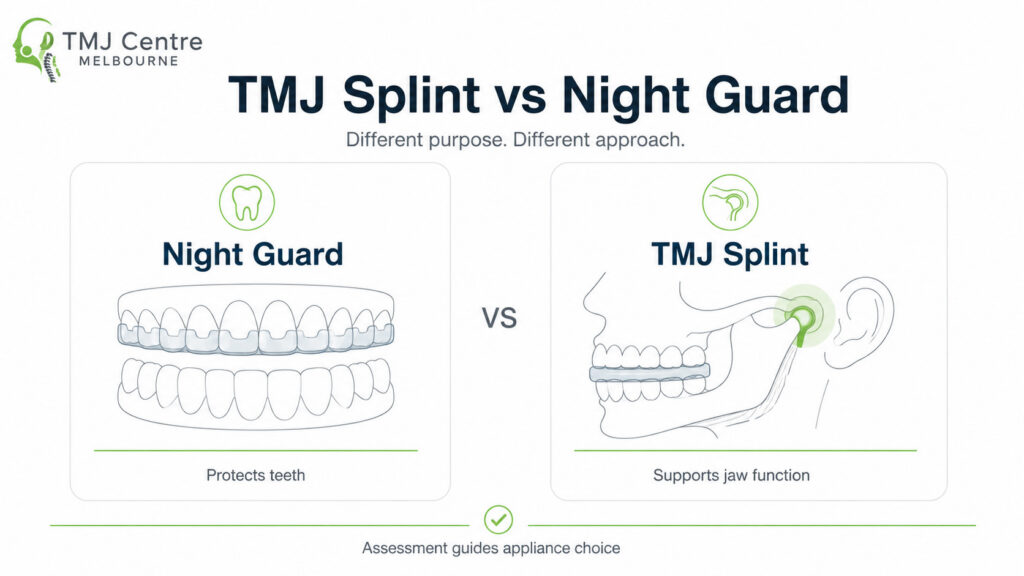
A night guard is usually made to protect the teeth from the effects of clenching or grinding. A TMJ splint is prescribed after assessing the jaw joints, chewing muscles, bite, movement and symptom pattern and designed for a particular jaw-related clinical purpose.
The important difference is not the name alone. It is why the appliance has been prescribed and how it has been designed. The right appliance depends on what is contributing to your symptoms. It should not be chosen based on jaw pain or tooth grinding alone.
What is the difference between a night guard and a TMJ splint?
A standard night guard is generally designed to protect the teeth and dental work. It creates a barrier between the upper and lower teeth, which may reduce wear caused by grinding or heavy tooth contact.
A TMJ splint, sometimes called a TMD orthotic, dental splint or occlusal appliance, is prescribed following an assessment of the jaw joints, chewing muscles, bite, movement and symptom pattern. Its design may be adjusted for a defined clinical purpose and reviewed as symptoms change.
In simple terms:
- A night guard is primarily designed to protect the teeth.
- A TMJ splint is designed to support the management of a particular jaw-related condition.
This does not mean one is automatically better than the other. A simple night guard may be appropriate when the main concern is tooth protection. A more specific splint design may be considered when pain, locking, restricted movement or other jaw-related symptoms are present.
Some people do not need an appliance as the first step.
What is a night guard?
A night guard is an appliance worn over the teeth, usually during sleep. It is commonly used to protect against the effects of bruxism, which means clenching or grinding the teeth.
A night guard may help protect:
- tooth enamel
- fillings and crowns
- veneers and other restorations
- teeth with existing cracks or wear
- sensitive areas affected by grinding
For example, someone may have clear signs of tooth wear but no jaw pain, headaches, clicking or difficulty chewing. In that situation, a protective night guard may be enough.
A night guard does not necessarily stop clenching or grinding. Its main role is often to reduce direct tooth-to-tooth damage.
What is a TMJ splint?
A TMJ splint is a custom dental appliance prescribed as part of a diagnosis-led approach to jaw symptoms.
Depending on its intended purpose, it may be designed to:
- protect the teeth
- distribute bite forces more evenly
- reduce strain on the jaw joints
- support a more stable jaw position
- reduce harmful loading on the chewing muscles
- guide the jaw temporarily in selected clinical situations
The design and intended role of the appliance depend on the findings from the assessment.
A splint does not cure every temporomandibular disorder or reliably stop clenching. Some people may find it helpful as one part of a broader conservative care plan, while others may benefit from a different approach or may not need an appliance at all.
Symptoms often occur together
Jaw-related problems rarely present as one isolated symptom.
Someone considering a TMJ splint may also experience:
- jaw pain or stiffness
- clenching or grinding
- temple headaches
- facial aching
- jaw clicking or locking
- difficulty chewing or opening comfortably
These symptoms do not point to one fixed diagnosis or treatment. Instead, they help build a broader clinical picture.
The timing of symptoms can also provide useful information. Jaw pain on waking may reflect a different loading pattern from discomfort that develops during computer work, driving or concentration later in the day.
Why diagnosis matters before choosing an appliance
TMD is not one condition. It is a broad term covering problems affecting the jaw joints, chewing muscles and related structures.
Jaw pain may involve:
- the temporomandibular joints
- chewing muscles
- teeth or dental structures
- ligaments and tendons
- neck-related referral
- clenching or grinding
- sleep-related loading
- several factors at once
The same symptom can have different causes.
Two people may both say they clench their teeth. One may grind mainly during sleep. Another may brace the jaw throughout the day. One may have muscle tenderness. Another may have joint pain, catching or intermittent locking.
This is why appliance design should follow the assessment.
The aim is not simply to make a splint. It is to determine whether an appliance is appropriate, what type may suit the clinical findings and what other factors need attention.
What is assessed before recommending a splint?
A TMJ assessment looks at the pattern of symptoms rather than one complaint in isolation.
This may include:
- where the pain is felt
- when symptoms are worse
- jaw opening and movement
- clicking, catching or locking
- tenderness in the jaw muscles
- signs of clenching or grinding
- the teeth, bite and dental restorations
- previous injuries, dental treatment or appliances
The assessment may also consider headaches, facial pain, ear symptoms and neck discomfort.
The goal is to understand where the symptoms may be coming from and what is contributing to the load on the jaw system.
The jaw does not work in isolation
Jaw function can be influenced by more than the joint and teeth.
Depending on the presentation, assessment may also consider:
- daytime clenching habits
- neck and postural strain
- sleep quality
- snoring or waking unrefreshed
- stress and anxiety
- medication-related factors
- chewing load and repeated wide opening
- other persistent pain conditions
These factors are not always the cause. They may, however, influence muscle activity, sensitivity and how the jaw responds to everyday load. It means the care plan can address factors that may be modifiable.
Types of TMJ splints
Not all TMJ splints are designed in the same way. Below are some examples of some splints we use and why they might be prescribed:
Stabilisation splints
A stabilisation splint is designed to create more controlled tooth contacts and distribute forces through the teeth, muscles and jaw joints.
It may be considered when clinical findings suggest muscle overload, clenching-related pain or joint loading. It does not necessarily stop clenching. Its role is to manage the forces created during clenching or grinding.
Forward-positioning splints
Some splints guide the lower jaw slightly forward. These are different from standard night guards.
They may be considered in selected cases where joint mechanics, catching or locking are clinically relevant. They are not appropriate for every clicking jaw.
A painless click alone may not require active treatment.
Mandibular advancement appliances
Mandibular advancement appliances also hold the lower jaw forward, but they are generally used in snoring or obstructive sleep apnoea pathways.
They have a different purpose from a routine TMJ splint and require appropriate assessment, fitting and review.
Daytime orthotics
Some appliances may be used during the day for a defined period.
This may be considered when symptoms are linked with daytime clenching, jaw bracing or specific functional patterns. Daytime use requires clear instructions and regular review.
The aim is to support recovery, not create unnecessary long-term reliance on an appliance.
Night guard vs TMJ splint
| Feature | Standard night guard | TMJ splint |
| Main purpose | Protect teeth from grinding or clenching | Support a diagnosis-led plan for jaw symptoms |
| Main focus | Teeth and restoration | Jaw joints, muscles, bite forces and movement |
| Common context | Tooth wear or restoration protection | Jaw pain, muscle overload, joint symptoms or complex bruxism |
| Design | Usually protective | May be stabilising or designed for a specific clinical purpose |
When might a standard night guard be enough?
A standard night guard may be suitable when tooth protection is the main concern.
This may be the case when there is:
- tooth wear from grinding
- heavy tooth contact
- pressure on fillings or crowns
- no significant jaw pain
- no locking or restricted opening
- no clear functional limitation
The appliance should still be fitted appropriately and reviewed over time.
When might a TMJ splint be considered?
A TMJ splint may be considered when assessment identifies a jaw-related problem that an appliance could help manage.
This may include patterns involving:
- jaw pain with clenching or grinding
- morning jaw pain
- muscle tenderness
- pain with chewing
- jaw instability
- selected joint-related symptoms
- clicking with pain, catching or locking
- persistent symptoms despite a protective night guard
These symptoms do not automatically mean a TMJ splint is needed. They indicate that the cause should be assessed before an appliance is selected.
A splint is one part of treatment
A TMJ splint is often one tool within a broader care plan.
Depending on the assessment, care may also include:
- education about jaw loading
- strategies for daytime clenching
- temporary changes to chewing habits
- jaw exercises
- muscle-focused care
- neck and postural support
- sleep assessment where relevant
- stress-related support
Care is usually introduced in stages and reviewed over time.
People with similar symptoms may need different combinations of care because their contributing factors differ.
What should a splint feel like?
A well-designed splint should feel comfortable and passive.
It should stay in place without requiring you to bite into it or hold your jaw in an uncomfortable position. A short adjustment period may occur, but the appliance should not create progressively worsening pain.
Arrange a review if a splint:
- causes new or increasing pain
- feels unstable
- pushes the jaw into an uncomfortable position
- makes the bite feel persistently different
- wears unevenly or breaks
- no longer fits correctly
These changes may relate to the fit, tooth contacts, material, design or suitability of the appliance.
Why splints need review
A splint should not be treated as a set-and-forget appliance.
Symptoms, muscle activity and loading patterns can change over time. Appliances can also wear or lose balance.
At a review, the clinician may assess:
- comfort and fit
- tooth contacts
- wear patterns
- jaw movement
- joint and muscle tenderness
- changes in pain or headaches
- whether the appliance is still appropriate
A splint that was suitable at the beginning may need adjustment as symptoms change.
Common scenarios
Morning jaw pain and temple headaches
Someone who wakes with jaw tightness, temple headaches and sore teeth may have signs of overnight clenching or grinding.
A stabilisation splint may form part of the care plan if the assessment supports its use. Review remains important to check comfort, wear, symptoms and sleep-related factors.
Daytime clenching and afternoon jaw fatigue
Symptoms that build during computer work, driving or concentration may be linked with daytime clenching or jaw bracing.
A night guard may protect the teeth during sleep, but it does not address daytime loading. Management may focus on awareness, jaw rest position, work habits, muscle tension and neck strain.
Jaw clicking and intermittent locking
Painful clicking, catching or locking requires a different assessment from simple tooth grinding.
A standard night guard may not suit the joint behaviour. Care may instead involve education, monitoring, specific exercises, imaging in selected cases or another appliance design.
A night guard that is not helping
Ongoing symptoms do not automatically mean appliance therapy has failed.
The appliance may have been designed mainly for tooth protection. It may need adjustment, or the main contributors may include daytime clenching, joint pain, muscle overload, sleep or neck factors.
Sometimes a different appliance is appropriate. Sometimes another appliance is not the answer.
Which appliance do I need?
You may need a standard night guard when protecting the teeth is the main goal.
You may need a TMJ splint when assessment identifies joint, muscle or functional factors that require a more specific appliance design.
You may need neither if another conservative approach should come first.
The decision should be based on the diagnosis, clinical findings and overall pattern of symptoms.
When to arrange a TMJ assessment
A TMJ assessment may be appropriate if you have:
- ongoing jaw pain
- pain when chewing
- painful clicking or locking
- restricted mouth opening
- morning jaw pain or headaches
- clenching or grinding with pain
- facial or temple pain
- a night guard that is uncomfortable or not helping
An assessment can help clarify whether an appliance is suitable and what other factors may need to be addressed.
Key takeaways
A night guard and a TMJ splint are not always the same.
A night guard is generally used to protect the teeth from clenching or grinding. A TMJ splint is selected after assessment and may form part of a broader plan for jaw joint, muscle or functional symptoms.
Not all splints have the same design or purpose. Choosing an appliance starts with understanding the cause of the symptoms.
Frequently asked questions
A night guard is usually designed mainly to protect the teeth from grinding or clenching. A TMJ splint is selected after assessment for a specific jaw-related clinical purpose.
Not necessarily. A splint may help manage the forces created by clenching, but daytime clenching and jaw bracing may also require awareness strategies, habit changes and other forms of care.
Not always. Painless clicking can be common and may not require treatment. Clicking with pain, locking, catching or restricted opening is a better reason to arrange an assessment.
An appliance may temporarily affect how the bite feels when it is removed. Persistent bite changes, new pain or increasing instability should be reviewed.
Snoring, waking gasping, morning headaches or feeling unrefreshed may indicate that sleep should be considered as part of the assessment. Referral to a GP or sleep clinician may be appropriate.
If you continue to experience jaw pain, headaches, locking or difficulty chewing despite wearing a night guard, reassessment may help clarify what is contributing to your symptoms.
A TMD assessment considers the jaw joints, chewing muscles, teeth, movement and overall symptom pattern. This can help determine whether your current appliance needs adjustment, whether another design may be appropriate or whether treatment should focus on another contributing factor.