
If you wake up with a sore jaw, sensitive teeth or tension around your face, you may have been told that a night guard could help. But does wearing one actually stop you from grinding or clenching your teeth? And if you start wearing one, will you need it for the rest of your life?
A night guard may help protect your teeth from the effects of grinding, but it does not necessarily stop grinding or clenching itself. Whether an appliance is appropriate, and how long you need to wear it, depends on your individual circumstances.
Understanding what a night guard can and cannot do is an important part of managing these symptoms.
Does a night guard stop teeth grinding?
A night guard is commonly used to help protect teeth from the forces generated during sleep grinding. It creates a barrier between the upper and lower teeth, although the jaw muscles may continue to work while the appliance is in place.
Teeth grinding and clenching are often grouped under the term bruxism. Sleep bruxism involves jaw muscle activity during sleep, while awake bruxism may involve clenching, sustained tooth contact, jaw bracing, or other repetitive jaw muscle activity during the day.
These behaviours are not necessarily caused by the same factors and may require different management approaches. Our article on bruxism and its relationship with TMJ disorders explains this in more detail.
Depending on its design and intended purpose, a night guard or dental appliance may help:
- Protect teeth and dental restorations from grinding forces.
- Change how pressure is distributed across the teeth.
- Support the management of certain jaw symptoms.
- Reduce some of the consequences associated with clenching or grinding.
However, protecting the teeth and stopping the underlying muscle activity are two different things.
The Australian Sleep Health Foundation’s information on teeth grinding and bruxism also explains that mouthguards may help protect teeth without necessarily stopping bruxism.
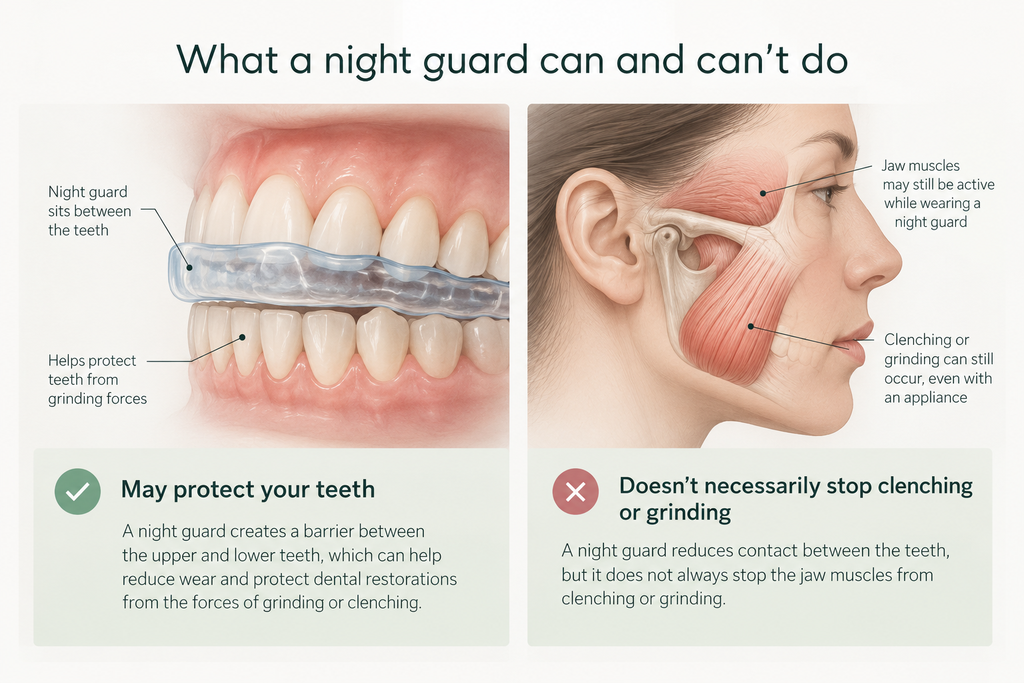
Dental illustration showing how a night guard protects teeth while jaw muscles may continue clenching
Can a night guard help with jaw clenching?
A night guard for clenching may be appropriate for some patients, but not everyone who clenches their jaw needs one.
For example, someone who grinds their teeth during sleep may primarily need protection against tooth wear. Another person experiencing jaw muscle pain, restricted movement or symptoms associated with a temporomandibular disorder (TMD) may require a different assessment and management approach.
The type of appliance matters too.
Although terms such as night guard, dental splint and TMJ appliance are sometimes used interchangeably, they may describe appliances designed for different purposes. We explain the difference between a TMJ splint and a night guard in a separate article.
The decision to use an appliance should be based on your symptoms, diagnosis, jaw function and treatment goals. You can also learn more about how orthotics and splint therapy may form part of an individualised management plan.
Importantly, not all jaw pain is caused by clenching, and not every type of jaw pain will respond to an appliance.
Will I need to wear a night guard forever?
Not necessarily. There is no single wearing schedule that suits everyone, and an appliance should not automatically be prescribed for lifelong use without review.
How long you need to wear a night guard depends on why it was recommended, whether it is achieving its intended purpose and how your circumstances change over time.
Some patients may continue to need protection against tooth wear if sleep grinding persists. For others, the wearing schedule may be adjusted following reassessment.
Your dentist may consider:
- Whether there are continuing signs of tooth wear or damage.
- Whether the appliance is achieving its intended purpose.
- Whether jaw pain, stiffness or other symptoms have changed.
- Whether the appliance continues to fit correctly.
- Whether other management strategies may be appropriate.
Regular reviews are important, even if you have been wearing an appliance comfortably for some time.
What else can help manage teeth grinding and clenching?
An appliance is only one possible part of managing bruxism and related jaw symptoms.
For people who clench during the day, becoming more aware of sustained tooth contact or unnecessary jaw muscle tension may be helpful. Your clinician may recommend strategies to recognise and change these habits.
Sleep quality, certain medications, stress and other health or behavioural factors may also be relevant, depending on the individual. However, stress should not automatically be assumed to be the cause.
Where jaw pain is present, management may also involve education, self-management strategies or other treatments guided by the clinical assessment.
It’s important to recognise that evidence for oral appliances in treating TMD-related pain remains uncertain. The available evidence was of very low certainty and did not establish a consistent reduction in TMD pain across the conditions studied.
This reinforces why treatment decisions should be individualised rather than assuming that every person with jaw pain will benefit from a splint.
When should your night guard be reviewed?
If you’ve been wearing a night guard but your symptoms haven’t improved, or you’ve developed new discomfort, it’s worth having the appliance and your symptoms reassessed.
Arrange a review if you notice:
- Increasing jaw or facial pain.
- New difficulty opening your mouth or episodes of jaw locking.
- Pressure or discomfort affecting individual teeth.
- A persistent change in the way your teeth meet.
- An appliance that no longer fits comfortably.
These symptoms do not necessarily mean the appliance has caused the problem, but they should not be ignored.
If you’re concerned about your appliance, our article Can a night guard make TMJ worse? explores why some patients experience ongoing or worsening symptoms.
Rather than adjusting or replacing an appliance yourself, a clinical review can help determine whether the appliance, the original diagnosis or another contributing factor needs to be reconsidered.
Understanding whether a night guard is right for you
A night guard may be useful for protecting teeth and managing certain symptoms, but it is not a universal solution for grinding, clenching or jaw pain.
At TMJ Centre Melbourne, our dentists assess jaw movement, muscles, joints, teeth and pain patterns to understand what may be contributing to your symptoms.
Where an oral appliance is appropriate, its design, purpose and wearing schedule should be matched to your individual needs, with monitoring and follow-up as required.
If you’re experiencing ongoing clenching, grinding or jaw discomfort, an assessment can help determine whether an appliance is appropriate and what other management options may be worth considering.