
For practitioners
Refer a Patient for TMJ Assessment
TMJ Centre Melbourne accepts referrals for diagnosis-led assessment of temporomandibular disorders and related orofacial pain conditions.
Assessment is aligned with DC/TMD criteria and considers contributing factors such as sleep, cervical involvement and behavioural load where relevant.
Following assessment, we provide a structured written report outlining the working diagnosis, contributing factors and recommended management plan. We welcome shared care and case discussion where appropriate.

Clinical scope
What we assess
TMJ Centre Melbourne assesses temporomandibular disorders and related orofacial pain presentations where the source of symptoms may be unclear.
Assessment begins with the primary diagnosis and differential rather than a predetermined treatment. We assess the jaw joint, muscles and movement system, including whether examination findings reproduce the patient’s familiar symptoms.
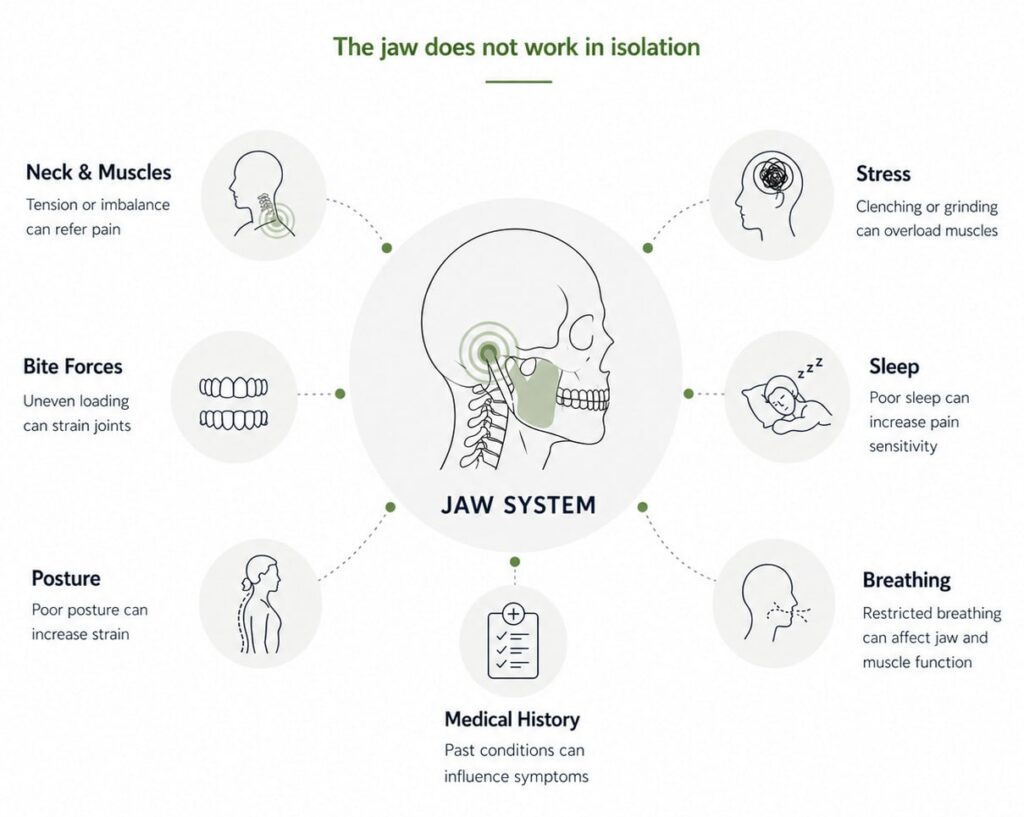
Where clinically relevant, assessment may also consider factors that influence loading, recovery or the persistence of symptoms, including:
- Jaw joint and movement
- Muscles and cervical function
- Dental loading and oral behaviours
- Sleep, breathing and recovery
- Pain, health and life context
The purpose is to distinguish the primary pain or movement disorder from factors that may be contributing to persistence, loading or recovery. Not every finding is causal, and not every contributor requires treatment.

Referral indicators
When to consider referral
Referral may be appropriate when the diagnosis is unclear, symptoms are persisting, or jaw pain is not responding as expected to conservative care.
TMJ-related pain often involves an overlap of joint, muscle, headache, cervical, sleep and behavioural factors. This can make the primary source of pain difficult to identify in general practice.
Consider referral when there is:
- Jaw pain, headache or ear symptoms with an unclear source
- Pain aggravated by chewing, clenching or jaw movement
- Morning jaw pain or headaches that persist during the day
- Persistent symptoms following trauma
- Symptoms lasting longer than three months
- Limited opening, deviation, clicking or locking
Earlier referral may help clarify diagnosis and guide appropriate conservative management.
Referral pathway
How to refer
Refer via the booking page
Ask the patient to book online
Call the clinic for urgent advice
Report and shared care
What happens after assessment
Following assessment, we provide a structured written report back to the referring practitioner.
The report outlines the working diagnosis, relevant contributing factors and recommended management plan. Where appropriate, it may also include guidance on shared care or interdisciplinary input.
This helps support continuity of care and keeps referring practitioners informed after their patient has been assessed.
Report may include
- Working diagnosis
- Relevant clinical findings
- Contributing factors
- Recommended management plan
- Suggested shared care considerations
- Review or follow-up recommendations

Clinical rationale
Foundational references
Our assessment approach is informed by key clinical frameworks and research that have shaped the diagnosis and management of temporomandibular disorders.
DC/TMD diagnostic criteria
OPPERA studies
Conservative care guidance
Practitioner education
Educational collaboration
TMJ Centre Melbourne welcomes educational collaboration with dental, medical and allied health teams.
We can provide practical education on recognising jaw pain presentations, screening for possible TMD and understanding when referral may be appropriate.
Educational sessions may include:
- Lunch and learn sessions
- CPD events
- Case discussion
- Jaw pain screening guidance
- Referral pathway education
TMJ Knowledge Centre
Patient Guides