

A jaw that suddenly becomes difficult to open or gets stuck can be uncomfortable and concerning. What you should do next depends on whether your jaw is locked closed or stuck open.
If your jaw is locked closed, avoid forcing it open. Choosing soft foods, heat and rest may help. If it does not resolve, contact the clinic for assessment.
If your jaw is stuck open and you cannot close it, do not force or manipulate it back into place. Try heat and rest, and if it does not resolve, seek urgent medical attention.
Seek urgent medical attention if jaw locking occurs following trauma, or with significant swelling, fever, difficulty breathing or swallowing, or an inability to eat or drink.
How to unlock a jaw safely
If you’re experiencing a locked jaw, it can be tempting to try to push, pull or manipulate it until it releases. However, a jaw can become locked or restricted for different reasons, so it is important not to force it open or closed.
Do not force or manipulate your jaw in an attempt to unlock it.
What to do next depends on whether your jaw is locked closed or stuck open.
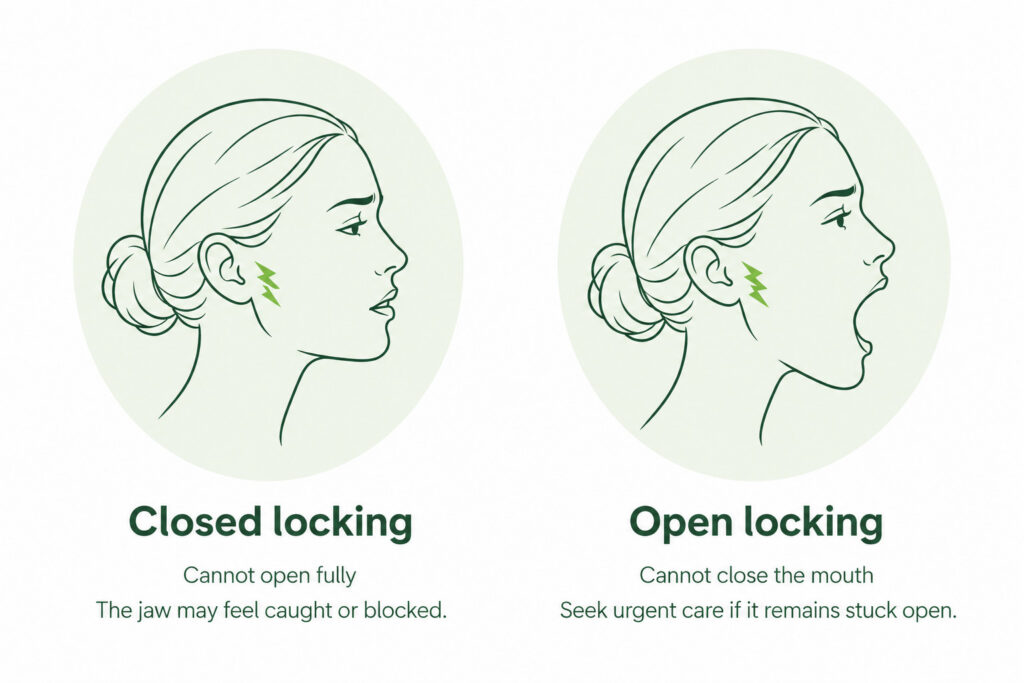
My jaw is locked closed and won’t open properly
When your jaw is locked closed, you can usually close your mouth but cannot open it as widely as normal. Your jaw may feel caught or blocked, opening may be painful, or it may move towards one side as you try to open. Your bite may also feel different, with your teeth not meeting in their usual way.
A true closed lock can occur when the articular disc within the jaw joint is displaced and does not return to its usual position during opening. However, restricted opening can also result from muscle guarding or spasm, muscle pain, joint inflammation, prolonged mouth opening, trauma or other conditions.
What should I do if my jaw is locked closed?
- Rest your jaw and try heat
- Choose soft foods and small bites to reduce uncomfortable chewing
- Avoid opening your mouth widely
- Avoid repeatedly testing how far you can open
- Do not force your jaw open or attempt to manipulate it yourself
If the jaw remains locked or your opening is suddenly much more limited than usual, contact TMJ Centre Melbourne for advice and assessment.
Learn more about the different causes of jaw locking, clicking and restricted opening.
My jaw is stuck open and won’t close
An open lock occurs when your jaw becomes stuck in an open position and you cannot close your mouth normally.
A brief episode that releases by itself may represent a subluxation. If the jaw remains stuck open, it may represent a dislocation and requires urgent professional care.
What should I do if my jaw is stuck open?
- Do not force your jaw closed
- Do not try to manipulate or “pop” it back into position
- Rest your jaw and try heat
- If it does not resolve, seek urgent medical attention
If your jaw is currently stuck open and will not close, seek urgent medical or dental care or attend an emergency department.
When is a locked jaw an emergency?
Seek urgent medical attention if jaw locking or restricted movement occurs with:
- significant swelling
- fever
- difficulty breathing or swallowing
- an inability to eat or drink
- trauma to the jaw or face
If you are having difficulty breathing, call 000.
What if my jaw unlocks by itself?
If your jaw releases and movement returns to normal, you may not need urgent care. However, recurring locking or catching is worth having assessed.
Consider an assessment if your jaw repeatedly locks, episodes are becoming more frequent, your mouth opening has changed, or you experience pain or difficulty eating.
If you also experience clicking or other jaw sounds, read Why is my jaw clicking, popping or cracking?
Why does my jaw keep locking?
There is no single cause of jaw locking.
Changes in the movement or position of the articular disc can contribute to catching or locking. Restricted movement may also be associated with muscle guarding or spasm, pain and inflammation, prolonged mouth opening, trauma or other contributing factors.
This is why assessment is important if locking persists or keeps happening.
For a more detailed explanation, visit Jaw locking, clicking and restricted opening.
How is jaw locking assessed?
Assessment considers when the locking started, whether your jaw gets stuck open or closed, how long episodes last and whether they release by themselves. We also ask about pain, changes in how your teeth meet, difficulty eating, any injury or recent dental treatment, and previous clicking or locking.
A physical examination can then help determine what may be contributing and whether treatment or further investigation is appropriate.
Learn more about comprehensive TMJ assessment and diagnosis
Has your jaw started locking?
If your jaw has started catching or locking, has become more difficult to open, or episodes keep recurring, an assessment can help determine what may be contributing.
If your jaw is currently stuck open and will not close, seek urgent medical attention rather than waiting for a routine appointment.